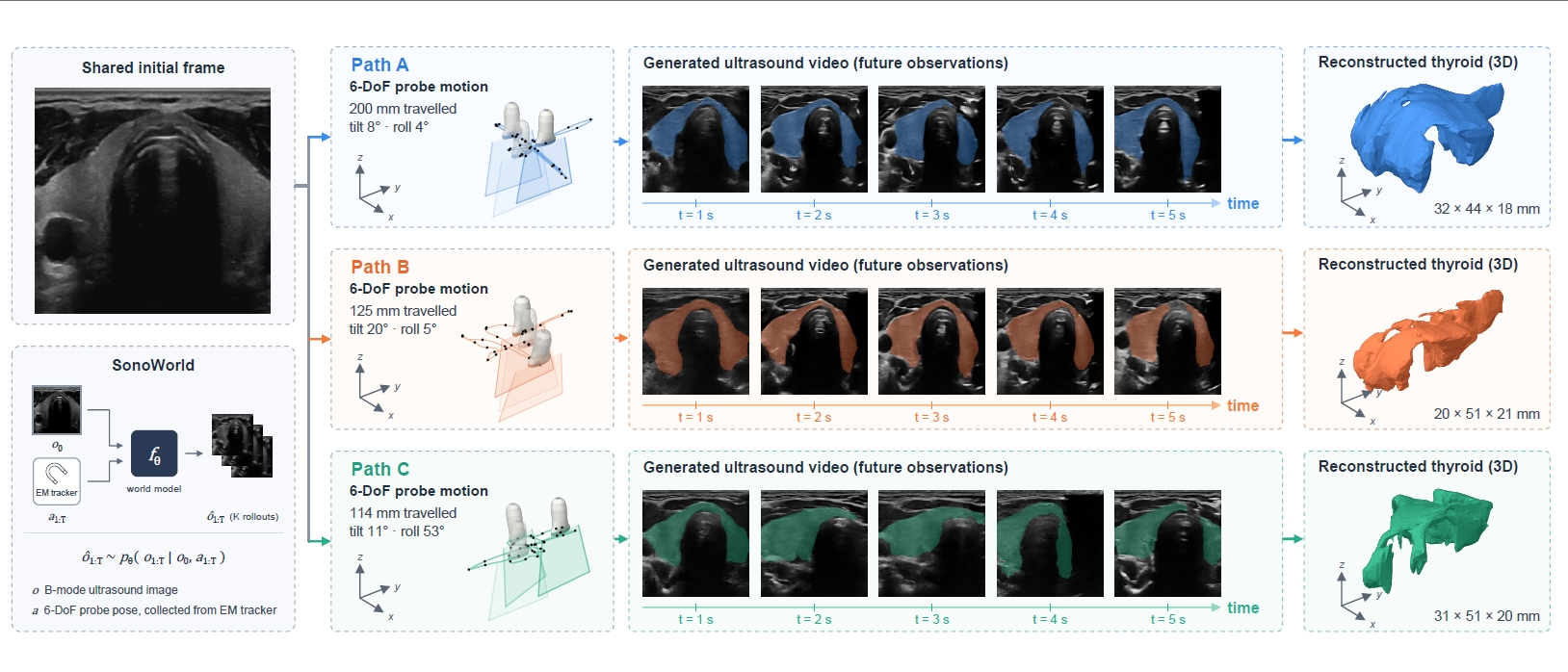
Robotic ultrasound can standardize image acquisition and reduce operator workload and variability, but policy learning remains limited by the lack of realistic, controllable simulation environments: physical phantoms and acoustic simulators exhibit a substantial domain gap from clinical images, and trial-and-error exploration on patients is unsafe. While controllable world models have advanced rapidly in natural-image domains, ultrasound world modeling remains challenging because each frame captures only a cross-section of unobserved 3D anatomy, causing small probe motions to induce large appearance changes. Existing approaches rely on robot-tracked poses and latent-space prediction, but do not directly generate the observations required for interactive control.
We propose SonoWorld, a causal ultrasound world model that learns video dynamics from unlabeled clinical videos and grounds them to 6-DoF control using a small set of freehand clinical scans tracked with an electromagnetic (EM) sensor. SonoWorld is trained in three stages: pretraining a latent-action-conditioned video diffusion model on around 6.7 million unlabeled multi-organ ultrasound frames; grounding the learned video dynamics to metric probe poses with a small EM-tracked thyroid dataset; and applying distribution matching distillation to enable causal, long-horizon autoregressive generation with selectively caching eviction tokens at inference time.
We evaluate controllability through pose-following fidelity, round-trip consistency, and axis-specific control under synthetic actions on held-out tracked scans, and further validate it with a user study. In model-based action discrimination, SonoWorld reaches thyroid target planes with a success rate above 74%. To our knowledge, SonoWorld is the first causal, pose-controllable ultrasound world model learned primarily from freehand clinical videos, providing a data-driven interactive environment for robotic ultrasound data acquisition and policy evaluation.
SonoWorld is trained in three stages:
Controllability is evaluated on held-out EM-tracked scans:
@inproceedings{sonoworld2027,
  title={SonoWorld: Towards Interactive Pose-Controllable Ultrasound World Models},
  author={Anonymous},
  year={2027}
}